Why it matters:
For Iran, one of the world’s most sanctioned countries, unilateral coercive measures represent a central foreign policy concern. These measures harm its economy, humanitarian conditions, and global trade, and considers any remaining Western restrictions after UN Security Council Resolution 2231 as violations of international law, sovereignty, and the right to development.
The big picture:
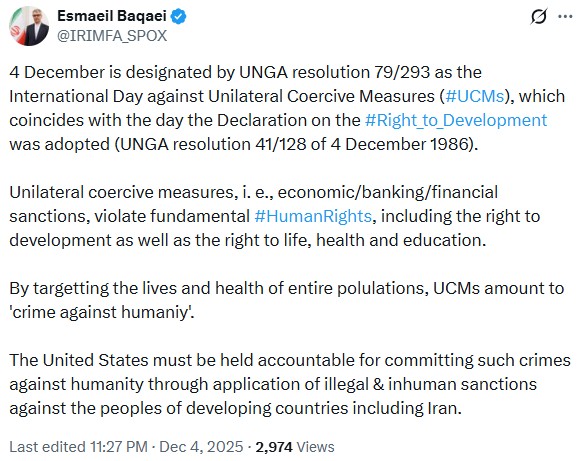
The message delivered by Iran’s Ambassador and Permanent Representative to the United Nations, together with a statement posted by the Spokesperson of Iran’s Ministry of Foreign Affairs on his X account for the International Day Against Unilateral Coercive Measures, underscores Tehran’s ongoing objection to the severe and unjust sanctions imposed on Iran by Western states, particularly the United States.
What they're saying:
Iran’s Ambassador to UN Amir Saeid Iravani:
"Unilateral coercive measures are among the daunting challenges that constitute a flagrant violation of the fundamental principles of international law and the principles set forth in the Charter of the United Nations, in particular, sovereign equality and non-intervention."
"Such unlawful measures also have serious humanitarian impacts, including by impeding affected populations’ access to medicine, medical services and equipment, and other essential commodities—effects that are further exacerbated during health emergencies, as the human suffering witnessed during the pandemic."
"We will continue our efforts in countering these unlawful measures to, among others, uphold the purposes and principles of the UN Charter and promote international cooperation on the basis of international law not coercion or intimidationand call upon the Secretary-General to appoint a “Special Advisor on Unilateral Coercive Measures.'"
Spokesperson of Iran's Ministry of Foreign Affairs Esmail Baghaei on X:
"Unilateral coercive measures, i.e., economic/banking/financial sanctions, violate fundamental #HumanRights, including the right to development as well as the right to life, health and education."
"The United States must be held accountable for committing such crimes against humanity through application of illegal & inhuman sanctions against the peoples of developing countries including Iran."
Zoom in:
In international terms, unilateral coercive measures refer to sanctions imposed by a state or group of states without UN Security Council authorization, aimed at influencing another state’s political or economic behavior. Many nations argue that such measures bypass the UN’s collective security system and can violate principles of sovereignty, non-intervention, and the right to development. The United Nations has designated 4 December as the “International Day against Unilateral Coercive Measures.”
Go deeper:
Iran, Russia, China affirm end of UN Resolution 2231
'Tehran Will Never Surrender to Threats', Iran’s UN Envoy Says
F.abedi - seyed mohammad kazemi